







How Lindsey Vonn’s Comeback Redefines Modern ACL Recovery—and How Tech Is Helping Everyday Athletes with Their Comeback
BlogFeaturesMore SportsNewsNewsTickerStaffPicks February 12, 2026 Lauren Keating 0
Expert Speak On Why Early, Guided Movement is Key
When Olympic alpine ski racer Lindsay Vonn announced she would compete in the Winter Games, many thought she was making a major mistake. Critics believed she was setting herself up for failure after suffering from a major injury leading up to the Games. Just days leading up to the 2026 Milan Winter Olympics, Vonn ruptured her ACL in her left knee after a crash during training. Many experts believed her season — and chance for Olympic glory — were over.
Despite the harsh impact of alpine skiing and a short recovery window, Vonn defied the odds and made it to the Winter Games. Along with showing resilience, Vonn’s decision revealed how disciplined recovery and trust in a structured rehab process can prevent athletes from missing major opportunities.
Unfortunately, Vonn crashed just 13 seconds into her downhill and needing to be airlifted by helicopter to treat a tibia fracture at the Games. Yet, her 2026 journey back to competing shows athletes that resilience is a skill, and it is possible to master recovery.
Thanks to sports medicine and technology, coming back to compete after an injury like Vonn isn’t such a far-fetched or even dangerous decision. While returning to sports should always be under the guidance of an athlete’s specific doctor, Vonn’s attempt at Olympic glory despite her injury shows that with smart recovery strategies, it is possible to continue to compete in certain cases.
In fact, recovery is part of training, not necessarily a break from it.
Owen Kent, Co-Founder + CMO of Assistive Technology Development, Inc (ATDev), a private medical-technology and assistive tech company, points to Vonn’s recovery arc as a powerful example of why early, guided movement—rather than complete rest or reckless return—is key to long-term success. From maintaining joint mobility to restoring neuromuscular control, intentional movement under professional supervision helps athletes heal stronger, not just faster. And this doesn’t just apply to Olympians.
“The biology of healing is the same whether you’re an Olympic skier or a high school soccer player. An ACL is an ACL. What differs is the resources, access, and intensity of the rehabilitation program around it,” Kent said.
While elite athletes like Vonn have access to the best surgeons, full-time physical therapists, advanced imaging, and advanced rehab facilities, the average athlete recovering from the same injury is trying to fit PT appointments around school, work, family, and insurance limitations. These exercises are often at home, unsupervised, with no feedback on whether they’re doing them correctly.</
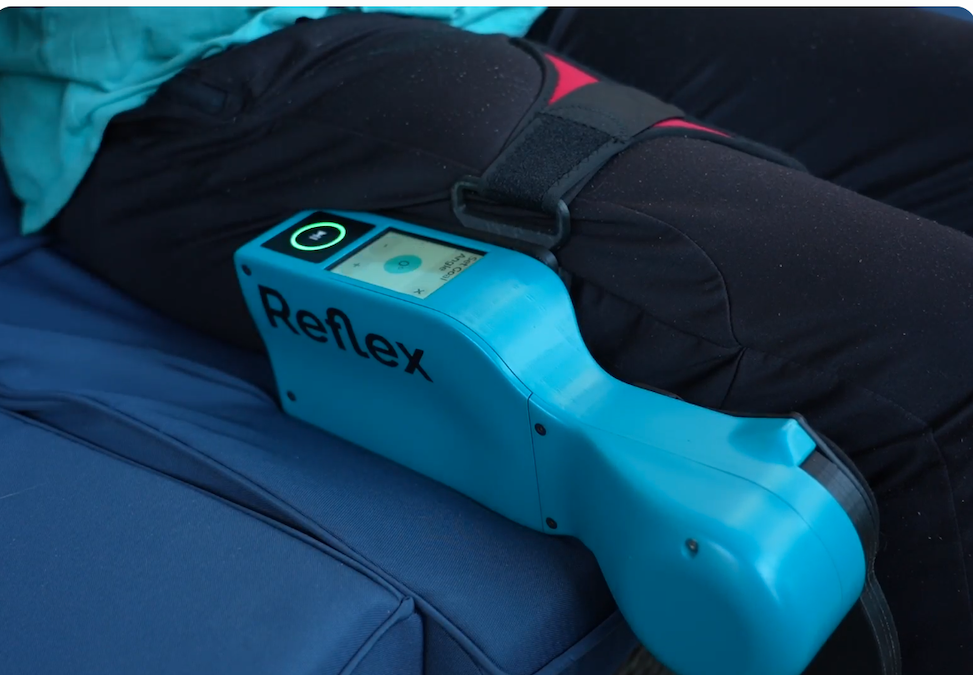
“That gap is exactly what we’re trying to close with Reflex,” he added, a robotic-assisted knee rehabilitation device that can be done at home with real-time telehealth monitoring. “The goal is to give everyday patients access to the same quality of guided, data-driven rehab that elite athletes get. You shouldn’t need a million-dollar support team to recover well from a knee injury.”
 <
<
Kent said there is an added concern among youth athlete injuries—the eagerness to return to sports before being ready. This puts them at risk for being re-injured.
For youth athletes specifically, there’s an added concern: young athletes are often eager to return to play before they’re truly ready, which puts them at high risk for re-injury.
“The biggest misconception is that there’s a fixed timeline, “You’ll be back in six months,” or “nine months and you’re good.” Recovery is not a calendar. It’s a biological process that varies enormously from person to person based on the severity of the injury, the quality of the surgery, the consistency and quality of rehabilitation, and individual factors like age, fitness level, and genetics,” Kent said.
A device like Reflex provides parents, coaches, and clinicians with objective data that enables them to make smarter and more informed decisions about returning to play. Recovery doesn’t stop once cleared to return. “Studies show that many athletes who return to play within the first year still have measurable strength and neuromuscular deficits. Vonn’s situation is extraordinary – competing at the Olympic level with a recently torn ACL is a testament to her individual resilience and the caliber of her medical team, but it’s not the standard anyone else should hold themselves to,” Kent said.</
He also noted that the quality of rehabilitation matters as much as (if not more than) the surgery itself.
The Evolution of Recovery
Why is early, guided movement now considered so critical in recovering from ACL injuries?

No comments so far.
Be first to leave comment below.